Posted on

Is BTL still a good move?

With a general election looming and the housing market a hot topic commentators differ in their opinions as to the direction in which property prices will go in the coming years.

As always with the property market it is, to an extent, something of a guessing game as the direction of travel depends on a plethora of factors.

However with some predictors citing 50% of the population being in rented accommodation by 2050 and with the average age of a first time buyer in the UK now 35, as opposed to 24 a decade ago, the buy-to-let option still appeals to many investors.

Becoming a landlord can be a rewarding experience and, if done correctly, provide a steady and sustainable return as an income investment, especially compared to lower savings rates and stock market swings.

Investors are snapping up property in the hope that it will not only return a reliable yield but also a benefit from capital growth given enough time. Mortgage rates at record lows are helping buy-to-let investors make deals stack up.

But beware low rates. One day they must rise and you need to know your investment can stand that stress test, a criteria sought by many lenders recently.

There is also a tax rise coming, as buy-to-let mortgage interest relief is axed and replaced with a 20 per cent tax credit. Additionally, from April 2016 landlords now have to pay an extra 3% stamp duty on property purchases.

Recent history provides an important lesson in how returns can be hit. Many buy-to-let investors who bought in the boom years before 2007 struggled as mortgage rates rose. A sizeable number were thrown a lifeline when the base rate was slashed to 0.5 per cent. Rates stuck there until this summer and then were cut again after Brexit, but they will rise again.

Even considering the recent tax changes and potential for buy-to-let mortgage costs to rise, there are many positives. We are becoming a nation who sees renting as a flexible lifestyle choice and is far more sociably acceptable. With greater demand from tenants, rents that should rise with inflation and the long horizon for interest rate rises, mean many investors are still tempted by buy-to-let.

If you are planning on investing, or just want to know more, here at HM Lettings we will guide you through essential things to consider and help avoid the pitfalls for a successful buy-to-let investment.

Like any investment, buy-to-let comes with no guarantees, but for those who have more faith in bricks and mortar than stocks and shares the opportunities are out there.”

Posted on

Average house price growth slowing, official figures show

Official figures from the latest UK House Price Index show that average house prices fell by 0.6% between February and March.

The data for March also shows that annual house price growth slowed to 4.1%, down from 5.8% the previous month.

The official index calculates that the average UK house price in March was £215,847.

There is again less than promising news for the capital, with the figures showing that average prices dropped by 1.5% between February and March.

London’s annual house price growth is now measured at 1.5%, well below the UK average. Despite this, average property prices in the city are still way out ahead at £471,742.

According to the index, prices in Wales have been performing strongly – rising by 1.4% between February and March, equating to annual growth of 4.3%.

The UK House Price Index replaced the Office for National Statistics and Land Registry indices last summer. It is published some way behind other reports like Rightmove’s – which monitors asking prices – due to the fact that it takes into account actual sales.

“While it may look as though house price growth is beginning to slow down, affordability remains a key concern for many aspiring homeowners struggling to get a foot on the ladder,” says John Goodall, chief executive and co-founder of Landbay.

“Furthermore, rising inflation and recent warnings from the Bank of England that a year of falling wages lies ahead means we’re unlikely to see any immediate relief.”

Jeremy Duncombe, director of Legal & General Mortgage Club, says: “With less than a month until the General Election, it is clear that housing needs to be a priority in all of the party’s manifestos.”

“The current government has made some admirable steps forward in tackling the serious shortage of affordable homes across the UK through the Housing White Paper, but there is still a long way to go.”

Posted on

Property cash purchases at new high

New research from IMLA has found that a record amount of cash was injected into residential property purchases in 2016.

According to IMLA, the total value of residential house purchases in the UK reached £261bn in 2016, with £152bn provided by mortgage finance and £109bn made up of cash funds including the proceeds of existing property sales.

Cash funds have risen by 12% from 2015 and 57% since 2013, far outpacing the growth of mortgage lending over the same periods. Growth of £6.8bn in house purchase mortgage lending from 2015 to 2016 was overshadowed by the extra £11.8bn in cash contributions. As a result, cash provided 41.8% of funds for residential house purchases.

Three-quarters of the annual growth in house purchase lending came from first-time buyers in 2016. However, the growing influence of cash in the house purchase market has potentially negative implications for aspiring homeowners and home-movers.

Analysis from the CML suggests that outright cash transactions (with no mortgage finance involved) continue to make up just over a third of all transactions.

Peter Williams, Executive Director of IMLA, commented: “The shift towards cash is partly a consequence of trying to manage housing demand by restricting mortgage supply, with Financial Policy Committee actions in 2014 quickly layered on top of the Mortgage Market Review affordability rules. With the market having cooled and interest rate expectations shifted since then, there is a legitimate case for asking whether current restrictions on lending are still appropriate or have become over-zealous.

In the meantime, rising house prices and stagnant incomes mean that access to wealth as well as mortgage finance will increasingly separate the ‘haves’ from the ‘have nots’ in the property market if the importance of cash continues to grow. The recent Housing White Paper was a missed opportunity to take strong action on housing supply, and we must hope that the upcoming election manifestos will be used as an opportunity to put that right.”

Posted on

How will changes to mortgage tax relief impact landlords?

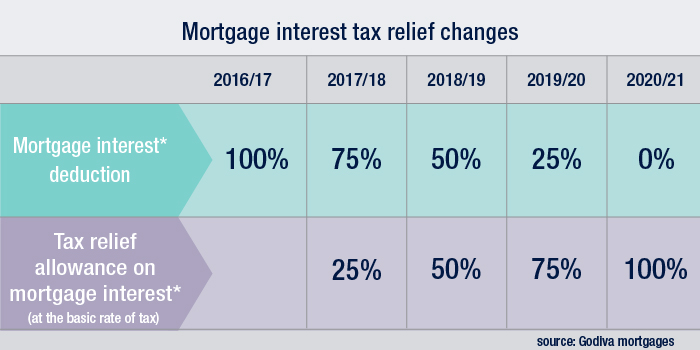
From April 2017, landlords’ ability to deduct mortgage interest payments from their rental income is gradually being phased out.

A recent study demonstrated that 47% of landlords did not know how the mortgage tax relief changes will affect them between now and 2020. The changes will be gradually phased in over the next four years so its important landlords review the changes and take action sooner rather than later.

Who the changes will effect

Any landlords who have a mortgage on a residential UK property. They do not apply to landlords of furnished holiday lets and commercial properties.

What the changes mean for landlords

Before April 2017, landlords were able to deduct both allowable expenses and mortgage interest costs from their rental income when declaring their profits to HMRC

The changes will be phased over the next 4 years:

By April 2020, landlords will not be able to claim tax relief on mortgage interest charges. Instead, landlords will receive a reduction on their final tax bill equating to 20% of the mortgage interest costs regardless of their tax bracket.

Some landlords who are currently on the threshold of a higher tax bracket may be forced into the next band and see an increase in their tax liability.

How landlords can negate the changes

The only way around these changes are to own your properties as part of a limited company. However, this can have implications in terms of national insurance tax and might not always be the most financially viable option.

These changes stress the importance of landlords ensuring they are making the maximum profit from their investment. The first step is to obtain an up-to-date, accurate rental valuation and, if demand is strong for similar properties in your local area, your letting agent will advise an increase in rent.

Posted on

A quarter of all homeowners rely on friends and family to help purchase their property

New analysis and research by Legal & General and the Centre for Economics & Business Research (Cebr) shows that, in 2016, home buyers will receive £5 billion of help from families’ and friends – equivalent to the annual lending of a top-ten mortgage business.

For many aspiring homeowners, it is impossible to buy without help from family and friends. On the other hand, recent decades have been much kinder to the baby boomers who now control the lion’s share of the nation’s wealth. Beneficiaries of the increase in the value of their homes and with good pensions and significant savings, many are in a strong position to help. And they are generous in doing so:

The latest research shows the Bank of Mum and Dad will help 305,900 of their loved ones buy a home in 2016, giving an average of £17,500 to each to fund the purchase of £77bn worth of property. This means the Bank of Mum and Dad will be involved in 25% of all mortgage transactions in 2016.

A quarter of all home owners, 32% in London, and 57% of the under 35s received help from friends and family to buy the home they live in. That proportion will grow in future: A third of all prospective home owners say they will get help when they buy.

As prices rise, wages trail and affordability worsens in coming years, an increasing number of house buyers across the country will rely on friends and family to plug the gap. How long they can do so is open to question.

There are opportunities for The Bank of Mum and Dad to expand. Releasing equity among the over 55s who already own their home is, at present, barely used. Only 3% in our survey had taken the opportunity, and another 3% said they were considering it. Even that represents a vast source of wealth, though, which could help house 413,000 more families. Lifetime mortgages would appear to be an ideal solution for many families looking to unlock their accumulated property wealth without having to move home. There might be opportunities in new solutions such as peer-to-peer lending, too.

Things are even worse for those families living elsewhere who try to finance their children buying in the capital or other property hot spot. Fundamentally, for all their generosity, our research shows that families and friends cannot solve a UK housing crisis caused by too few homes. It’s not fair on those without wealthy families, and it’s not sustainable in the future.

Nigel Wilson, CEO of Legal & General, said: “The Bank of Mum and Dad continues to grow in importance in helping young people take their early steps onto the housing ladder. The intergenerational inequality that creates the demand for BoMaD funding continues to widen – younger people today don’t have the same opportunities that the baby-boomers had, including affordable housing, defined benefit pensions and free university education. Parents want to help their kids get on in life, and the Bank of Mum and Dad is a testament to their generosity, but it is also a symptom of our broken housing market.

This is the second year of our Bank of Mum and Dad research programme and the statistics show the problem is getting worse, not better. Transaction volumes are down in the housing market but BoMaD funding is growing exponentially. This is not a good thing, nor is it sustainable or equitable for our parents (the lenders) and young people (the borrowers). We need real action to fix the housing market and restore affordability for all.

Posted on

Grown-up children living with parents top a million

The number of older adult children living with parents has surged past a million as runaway house prices have left a generation without a place of their own.

More than 1.23 million 25 to 34-year-olds are still at home, a 40 per cent increase on ten years ago, a study has found. The rise coincides with a 45 per cent leap in house prices, with the cost of the average first home rising from £146,000 to £211,000 over the period.

If the growth pattern continues at the same rate over the next decade, the UK could see a further 452,000 people aged 25 to 34 living with their parents.

The report, based on ONS data, says the situation has got so bad that almost one in five 30 to 34-year-olds never expects to move out, let alone buy. Younger people are slightly more optimistic with about one in ten 25 to 29-year-olds anticipating being at home indefinitely.

Most are “happy” with their situation but happiness falls with age, the research suggests. By 30, almost a third said they were unhappy, double the proportion in their twenties.

Lindsey Rix, of Aviva, the insurer, which conducted the analysis of the data, said: “The challenges of getting on the property ladder are well publicised but it’s startling to see that one in three adults who live with parents expects never to own a property and a further fifth believe the only way they will own a home is by inheriting one.”

Posted on

Survey confusion among buyers

A new survey has found that many home owners do not know who is responsible for advising on the physical condition of a property prior to purchase.

Additionally, they are unclear on the purpose of a mortgage lender’s property valuation report, suggesting a need for greater clarity within the home-buying process.

When asked who benefits from the data contained in a mortgage valuation, respondents were not clear with many opting to choose incorrect answers. 65% correctly stated that the valuation report is for the benefit of the mortgage lender, yet over a third (35%) thought it is for buyers to use to determine whether the property is worth the agreed purchase price.  Just over a quarter (26%) felt it is there to provide buyers with details on the condition of the home, while 15% of respondents directly stated that they did not know what the valuation report is for.

When asked what would help improve the current home-buying process;  

• Seven out of every 10 respondents said they would like to receive information upfront regarding the physical condition of a property
• 58% said it would be desirable to receive outline costs for specific repairs needed to a property prior to purchase,
• 45% felt that receiving upfront information relating to environmental issues connected to the property would be beneficial.

Paul Wareham from Countrywide Surveying Services, who commissioned the survey along with Landmark Valuation Services, said:
“The YouGov survey shows a general lack of understanding as to who people should turn to when looking for assistance with assessing the physical condition of a property, before they buy.

With seven out of every ten respondents saying they would like to receive information on the physical condition of a property upfront, it raises a number of questions, are we as an industry, meeting the needs of the consumer with our existing approach and products; plus with an election around the corner do we need to refresh our home-buying approach looking again at Home Reports as a mandatory step in the process, as per the current protocol in Scotland?

It’s clear that from the survey that consumers really do need better information to ensure that everyone is entering a property transaction ‘eyes wide open’ as to any potential issues or risks.”

Michael Holden, Head of Client Relationships at Landmark Valuation Services said: “A study by ComRes for RICS showed that, on average, homebuyers spend £5,750 on repairs once they have moved into their homes, which is often down to not getting the right survey done.  If the public were more aware of what surveys and reports are out there, there would be greater transparency for all involved. There is certainly an appetite for home owners to have an understanding of a property’s condition before they buy it however there certainly appears to be confusion as to how this can be achieved.”

Posted on

Increase in thefts from UK driveways

According to the latest crime report from the Office of National Statistics, the UK has seen a 4% increase in the number of thefts as a result of domestic burglary and a 16% increase in the number of thefts from vehicle break-ins over the past year.

This is bucking a long-term trend of a gradual decrease in crime on UK streets since the mid-1990s and suggests that criminals are outsmarting some traditional security measures.

According to Police.UK’s February crime figures, Ilford isone of the UK’s most burgled postcodes and has seen a 55% increase in burglaries over the past year. Although the long-term decrease in UK crime is still evident, criminals appear to be less deterred from doorstep crime. The demand for more sophisticated home security to support police efforts is clear.

In addition to traditional home security measures it is important for communities to utilise new technologies in the fight against crime.

For maximum security a combination of both is suggested:

1. Use Smart Technology – Wi-Fi connected security devices, equipped with motion detectors, can send live video footage directly to your smart phone whenever suspicious activity occurs outside your home.

2. Lock up – Keeping all doors and windows locked every time you leave the house is essential to prevent opportunist thieves from easily entering your house.

3. Keep up appearances – If you are planning on going on holiday, make it look as if you are at home whilst you are away by mowing the lawn, keeping the curtains open and installing an automated porch light before you leave.

4. Visible Security – Visible security cameras are one of the strongest deterrents for Burglars.

Posted on

Top 10 household myths

Myths: we’ve all heard them before, whether they’re about eating carrots to help you see in the dark, not drinking coffee for fear of stunting your growth or waiting an hour to swim after eating.

Myths are everywhere, and it’s sometimes harder than you’d think to tell which you should believe and which are completely false.

Stephen Jury, Spokesperson for Plentific.com said, “We all have that one friend or family member that swears by an age old myth when it comes to home improvements and DIY. Whether it’s an energy saving tip or secret cleaning hack, knowing what actually provides results and what is a waste of time can be tricky.”

So, here at Plentific.com, we’ve compiled a list of ten popular home improvement and DIY myths that are false, to give you peace of mind when you decide to renovate your home.”

1. Solar panels don’t work on a cloudy day

With summer on the way, it may seem like the perfect time to invest and install solar panels, because everyone knows that solar panels need sunlight to work, right? Wrong! Although solar panels do work best on a sunny day, they are still functional on cloudy days. This is due to their ability to absorb UV and infrared light on cloudy days so that they can continue generating energy.

2. Leaving the heating on low all day is more efficient

Many people believe that leaving the heating on low all day is more efficient than turning it on as and when you need it. This  topic is widely debated on various heating and energy platforms, with the general consensus being that because no home is completely airtight there will always be a small degree of heat escaping from your home throughout the day.

Therefore, you will always waste heat, even if your system is on low. Only having the heating on when you need it would mean that there is no heat to be wasted when you’re not around, saving you money.

3. Bleach eliminates mould spores

This is a common misconception due to the fact that bleach will kill and remove the visible mould in question. However, bleach will not be able to get rid of the mould spores altogether. This can be done with a scrubbing brush, water, and an appropriate cleaning product such as detergent.

Once the cleanup has been done, it’s worth also investigating the cause of the problem and then treating it effectively to prevent the mould from returning. Remember, mould can be as bad for your health as asbestos!

4. Painting a radiator will make it more efficient

While it is a scientific fact that darker colours are better at absorbing and transmitting heat than lighter colours, covering a radiator in dark paint will not improve its efficiency.

The main way that radiators work is with ‘convective heating’, which essentially means that the radiator heats up the air around it. This is why some radiators have grooves or wings, as they increase the surface area and expose more air to the heat. Painting over a radiator can actually insulate this heat, which will in fact make the radiator LESS efficient!

5. The best time to water the grass is the evening

Another scientific fact is that heat evaporates water, so you would be forgiven for thinking that the best time to water your garden is in the evening once the sun goes down. Watering in the evening does have some benefits for soil, in that it is able to soak up and retain the water more efficiently. However, this also creates an ideal breeding ground for mould, fungi and other potential problems for your garden.

The best time to water your grass is, in fact, during the morning when the sun is first rising. This will ensure that the grass has time to absorb as much water as it needs to before the sun evaporates the excess throughout the day, preventing diseases and keeping your garden looking fresh for longer.

6. You can kill trees using copper nails

It’s an age old myth that copper nails can kill trees, but in an ordinary healthy tree a copper nail will not have much of an effect. In fact, it’s thought that some plants use copper as a source of proteins that are essential for photosynthesis. There have even been cases of trees being chopped down to reveal rings of copper nails that the tree has actually grown around!  The only way it seems this myth can be proved true, is by attaching a copper nail to the end of an axe when chopping it down!

7. Asbestos always needs to be removed for health purposes

Although in some cases this is true, there are exceptions where there is no need to remove asbestos within your home. Contrary to common belief, asbestos isn’t actually harmful to your health unless the fibers become exposed or disturbed due to home renovations or decorating. Still, although materials containing asbestos won’t necessarily affect your health if left alone, it’s always important to check them on a regular basis for wear and tear as this is when damage can be done.

8. Put conkers in your window sill and in the corners of your bathroom keeps spiders at bay

Many people will remember visiting their grandparents and finding little piles of conkers on the window sills and in the corners of the bathroom. The myth is that conkers contain a harmful chemical that wards off and can even kill spiders, making them ideal as a natural repellent. However, there is no scientific evidence to prove that this works. Instead of leaving conkers in your room to repel spiders, why not pop a couple in your wardrobe to keep moths away, as this is one myth that is proven to get results.

9. Coffee grounds unclog sinks  

This myth could be doing your sink more harm than good. In fact, coffee grounds are among some of the top causes of blocked drains. Emptying coffee grounds down a sink will create a build up of thick slushy material that may require a plumber to unblock. Some plumbers even compare it to pouring cement down the sink!

10. Turning your electronics on and off at the plug uses more energy than leaving them on standby

Switching appliances to standby mode instead of turning them off is a fairly common habit that many people have. Unfortunately, many electronic devices on standby mode will continue to use energy if the power is not cut at the source or the wall socket.

While some people believe turning devices on and off at the wallplug generates a surge in energy greater than leaving appliances on standby, this is often not the case. Having said that, the belief that turning off appliances at the switch stops the use of energy is also, in fact, false.

For more information, please visit https://plentific.com/

 

Posted on

Mortgage rates at record low

Mortgage rates continue to fall with the average new lending rate at a record low of 2.2 per cent: as a result the average monthly payment constitutes a lower share of income than in 2007 despite the average loan size being almost one fifth higher.

The steady decline in mortgage rates over the last nine years has seen the average new lending rate fall from a peak of more than six per cent in 2008, to today’s 2.2 per cent. As a result, and in spite of steadily rising house prices, mortgage interest costs as a percentage of income have been falling for the majority of homebuyers.

The NatWest, analysing data from the Council of Mortgage Lenders, says the median house buyer in the final quarter of 2016 had to allocate less than eight per cent of their income to mortgage interest, compared to a peak of 18 per cent in 2008 and a long-run average of 15 per cent.

The NatWest says that with quoted new lending rates half a per cent lower than the average rate on outstanding mortgages, it says it is likely that the interest cost burden will decline even further in the short-term.